|
|---|
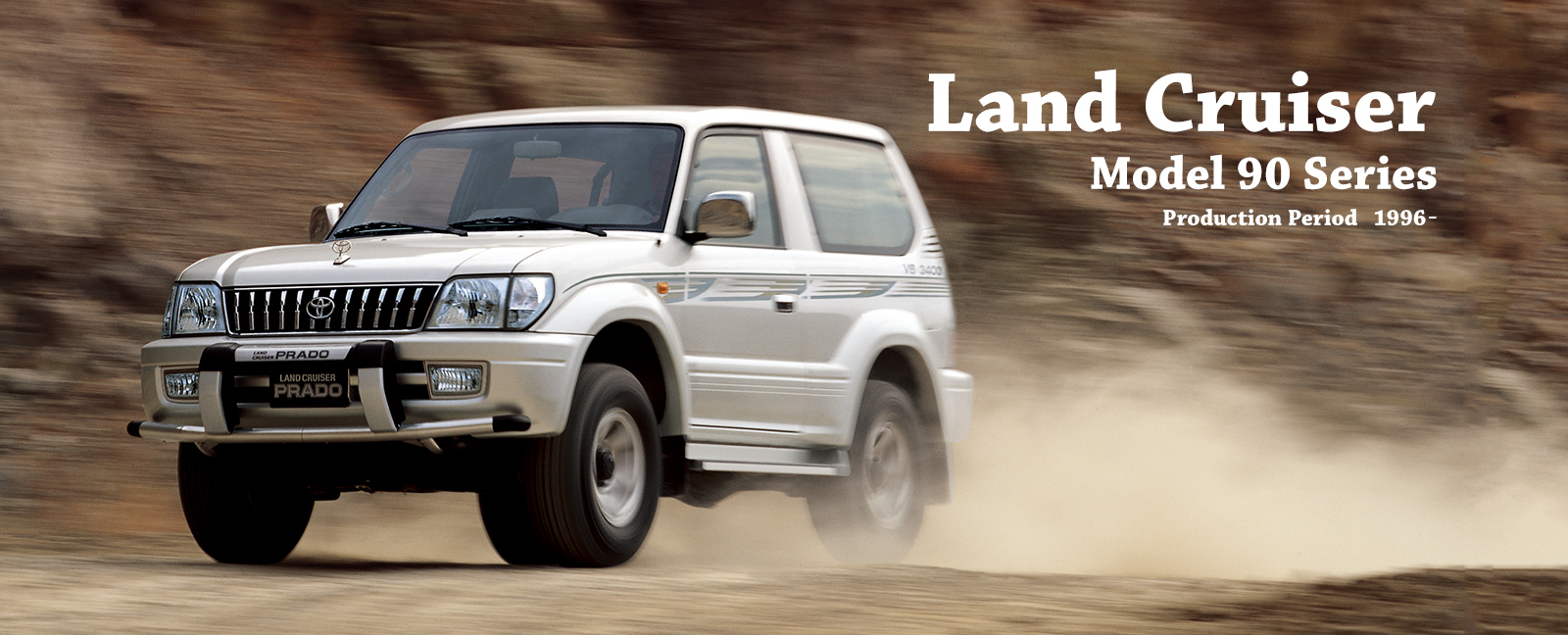
Toyota Land Cruiser 90 Prado.
Demand for a 4WD with easy-to-ride characteristics naturally grew with the enhancement of user types experienced during this particular time. Gaining momentum from these demands, the Mitsubishi Pajero began to aggressively expand its market share. That was the main reason for the introduction of the 90 series Prado.
In 1996 the 70-series underwent a makeover and emerged as the 90-series Prado, an independent series of itself. The design was heavy duty, like the 70-series Prado, however with a smaller engine and light classification it took on the image of an underpowered 4x4, and consequently domestic sales did not do as well as expected.
The 80-series was a tough competitor in the market, boasting better performance than its rival model in the class below it, the Mitsubishi Pajero. It did not really hold a candle either to the van type series, which had fully independent suspension, 3 rows of seats, driving comfort and luxury on a par with a passenger car. Even though they were in different classes by spec, the closer rival for the Mitsubishi Pajero was really the Toyota 4 Runner.
Toyota was aiming for supremacy in all classes, so it developed the 90-series Prado as its final weapon against the Mitsubishi Pajero. In addition to the standard size body there was also a wide-size body version, a sporty 3-door model as well as a 5-door model, which were all easy to distinguish from the outside. The 90-series Prado had a wide and low form, and looked amazingly similar to the Mitsubishi Pajero. Even the engine had similar specs, with two choices for the power unit, the 5VZ-FE-type gasoline engine (24-valve V6, 3,378cc, 185PS, 30.0kgm specs) and the 1KZ-TE-type diesel engine with intercooler (2,982cc, 140PS, 34.0kgm specs). The power train was a full-time 4x4, so that the lineup was clearly a front on comparison with the Mitsubishi Pajero. Like the 80-series, the long also offered a model called Active Vacation built for camping.
In this way the specs and the lineup of the 90-series Prado was a major change, but there was another secret behind its birth. Actually the 90-series Prado essentially shared the same chassis platform as the 4 Runner 185-series that had just debuted half a year before. From the time of the 70-series wagon these had shared the same type of engine, and were in a similar class. In a sense it was an inevitable response to user demand that it would take on independent suspension in the front.
This decision led to a big market success. It was featured in a television commercial, quite unusual for a 4x4, and it overtook the Mitsubishi Pajero as planned.

|
|---|
The 100 series debuted despite no apparent loss in popularity of the 80 series prestige SUV (Sports Utility Vehicle) which was at the pinnacle of its success. The luxuriousness even above the 80 series was aimed at being the world's top level and became an instant success.
In 1998 the Land Cruiser 80-series underwent a model change resulting in the release of a new series, the Land Cruiser 100. By this time the name Land Cruiser had earned a strong reputation worldwide for its high performance on bad roads, maneuverability, durability; and as one of the most reliable 4x4s available it had been selected by the United Nations procurement, as well as domestically and overseas for rescue operations, as a relay vehicle for satellite broadcasting, and as a prestige SUV.
For the wagon version a new 2UZ-FE-type V8 gasoline engine was developed, with 32 valves, a piston displacement of 4,663cc, 235PS and 43.0kgm in the specs. For the van model also a new 1HD-FTE-type diesel engine was developed, a 24-valve in-line 6-cylinder engine with a piston displacement of 4,163cc, an output of 205PS and 44.0kgm of torque. Both of these new engines were state-of-the-art power units engineered for low fuel consumption and low emissions.
The front suspension was a double wishbone type independent suspension, and with rack and pinion steering, the Land Cruiser 100 was designed to feel more like a passenger car than its heavy-duty predecessors. To further improve riding comfort and steering stability, hydraulic vehicle height adjustment (AHC) and Skyhook TEMS in the suspension were also made available as options, clearly aiming at improved performance on paved roads.
The interior was luxurious of course, with air-conditioning and an audio system befitting a luxury car.
In 1999, well-received systems like Active TRC (Traction Control System) and the vehicle stability system VSC were added to the 90-series Prado. Then in 2000, along with minor changes and improvements introduced, for theft prevention an engine immobilizer system and other security systems were added to all grades as standard equipment.
Though the Land Cruiser 100 continues to evolve on the path of the passenger car, there are still users overseas who drive it off-road. To meet these needs such as in Australia and other rugged environments, Toyota has created a Land Cruiser 105-series with rigid coil springs in the suspension. No matter how much it takes on the aura of luxury, the Land Cruiser is never far from its roots as an off-road vehicle.

|
|---|
Continuing the tradition of the preceding 90 Series, the Land Cruiser underwent a full model change in 2002 with further enhanced outstanding drivability under grueling conditions. The quality of the interior and exterior has also been thoroughly refined for a pleasant on-road driving experience that looks set to create a new legacy in the Land Cruiser Prado tradition. In terms of performance, the front suspension features an independent double wishbone structure while the rear adopts a 4-link axle suspension. A newly designed and exclusive high rigidity frame provides superior maneuverability and running stability while also offering a comfortable ride. The new Land Cruiser not only evolves off-road driving characteristics, but also fully enhances its on-road driving performance. In addition to the adoption of a new frame, the effective placement of sound reducing and absorbing material and the new flush body surface result in quiet road, wind, and engine noise on par with a medium-high class passenger sedan. Newly developed Torsen LSD (Limited Slip Differential) is used for the center differential and distributes 40:60 front/rear basic driving force with automatic and instant adjusting to ideal distribution of front and rear torque according to road conditions for enhanced tractability during turning. This has resulted in superior on-road driving as well as superior traction in slippery conditions such as on icy roads. In addition, an active TRC (TRaction Control system) independently controls braking at all four wheels with an active wheel speed sensor semiconductor for superior control when climbing and descending. Furthermore, DAC (Downhill Assist Control) enhances vehicle stability when descending steep slopes, while Hill start assist control depresses vehicle rearward motion when climbing steep slopes. H?-TEMS, which uses the latest control logic and non-linear H? control, is available as a high-grade option for the combination of a comfortable ride and stable road stance. The newly available rear electronic control air suspension with vehicle height adjustment enhances both on-road and off-road driving performance, and also controls vehicle posture when the vehicle is loaded.
The Land Cruiser is available with the following three engines: a V6 3.4-liter gasoline, a V6 2.7-liter gasoline, and a 3.0-liter diesel turbo engine with intercooler. The automatic transmission has a flexible lock up system with a lock up clutch and greater operating range expanding to low speeds, while the diesel engine vehicles are the first to feature a 1KD-FTV engine. Also featured is hill climb and descent gearshift control that prevents unnecessary up/down shifting when climbing and descending hills..

|
|---|
The Prado may also be referred to as Land Cruiser LC70 , LC90, LC120, and LC150 depending on the platform.
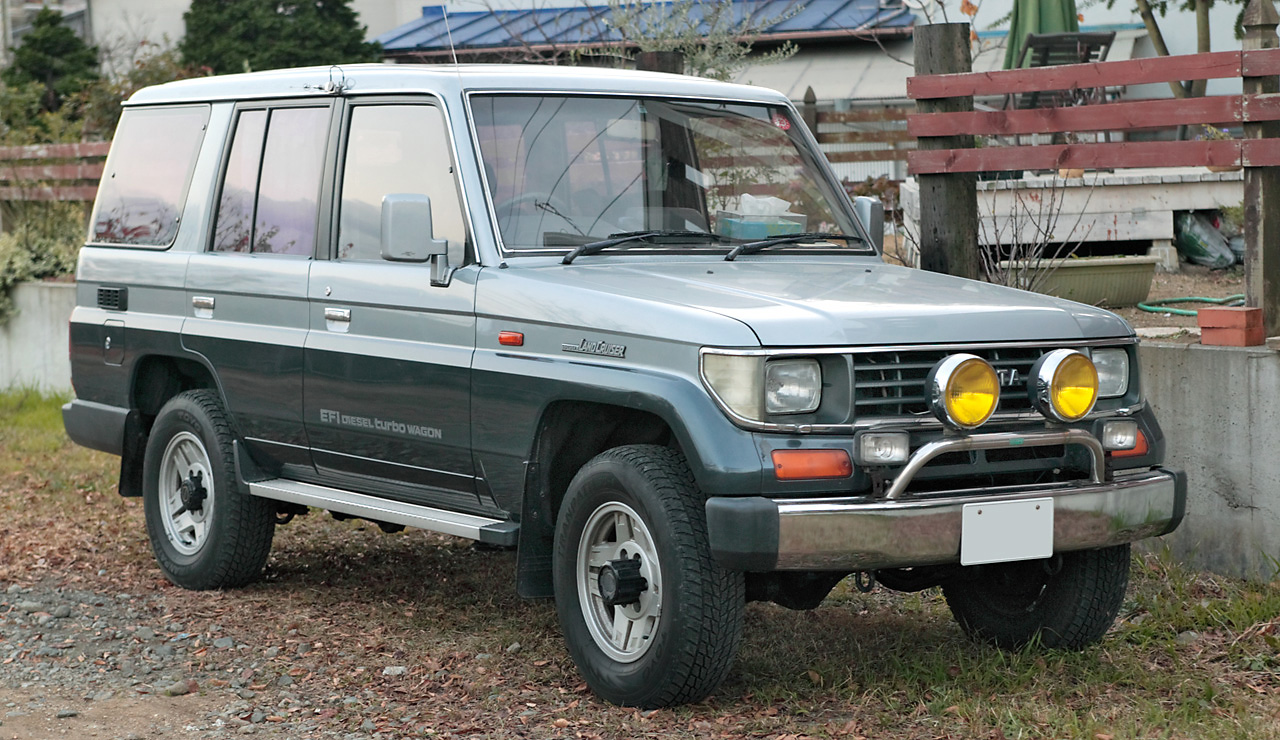
In North America, the Prado is not part of the Land Cruiser range; the Toyota 4Runner replaces the Prado with basic trim while the rebadged Lexus GX occupies the Prado's position in luxury trim. The GX uses practically identical body panels and V8 engine.
Prados have ladder frames, two-speed transfer boxes and rear beam axles. The J70 platform has a front beam axle while the J90, J120, and J150 platforms have front independent suspension.
As of 2014, the LC Prado is available in every Toyota market, except the US, Canada (both available as the Lexus GX), Mexico, and South Korea.
Predecessor (J70: 1984–1990)
First generation (J70: 1990–1996)
Second generation (J90: 1996–2002)
Third generation (J120: 2002–2009)
Fourth generation (J150: 2009–present)